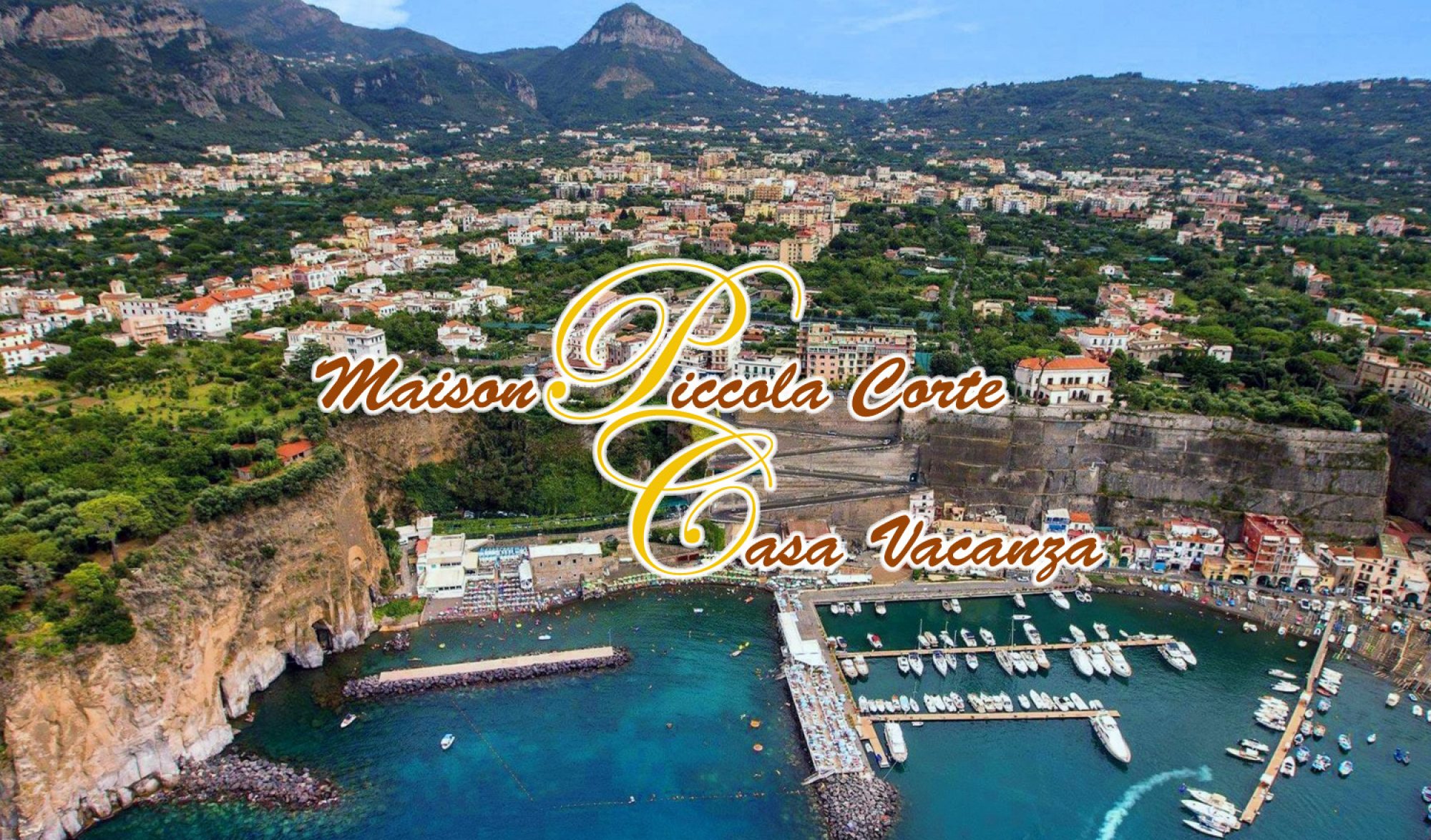
Our location:
Maison Piccola is located in the historic center, 500 meters from the main square Piazza Cota where the style of the Sorrento peninsula predominates and close to the shops.
Around us You may reach:
• bathing establishments with bars, restaurants and beaches 1.5 km away, wonderful sandy beaches 1.5 km away from the structure;
• rocky beaches 3 km from Meta di Sorrento;
• 5 km away with the famous Lido “Bagni Regina Giovanna” where they shot several scenes from the film Pane amore e … by De Sica;
• natural reserve of the Lattari mountains park, Monte Faito at 20Km;
• Amalfi 25 km away, Positano 10km, Ravello 32 km, Capri 25km (13.5 nautical miles from the sea), Ischia and Procida about 100 km (50 nautical miles from the sea)
• supermarkets 30 meters from the property;
• tobacconist and newsstand 30 meters from the structure;
• hospitals in Sorrento, etc. (maximum 4 Km)
• motorway at 7 Km
Services
The staff of the structure is available for information and additional services, in fact they offer the services of Trekking excursion in the Sorrento Peninsula, such as PUNTA CAMPANELLA, a path close to the island of Capri. It was the ancient Roman road, Via Minerva, which leads from Termini to the final point of the peninsula, called Punta Campanella, which attracts romantics with its magic, once home to a temple dedicated to Athena (Under the Romans: Minerva ), today on this site there is a medieval tower and some remains of Roman walls and a modern lighthouse. Staying at Punta Campanella you can enjoy the sunset over Capri, while from the top of Monte San Costanzo you can enjoy the magnificent view over the bay of Ieranto, one of the wildest places in the Mediterranean. For the boat excursion services starting from Sorrento, we offer a tourist route, from which you can reach Capri in just over 20 minutes of navigation and where you can admire the natural caves around the island, such as the famous Blue Grotto, the majestic Faraglioni, symbol of the island in the world and visit the city center of Capri and Anacapri. Or aim to discover Positano and Amalfi, sailing along the Amalfi Coast, a UNESCO World Heritage Site, of Ischia and Procida in just 45 minutes of navigation and, in this way, spend a relaxing day discovering the wonders of these two islands. Take a seat, and welcome!
What to Visit
POSITANO
It is the first town you meet on the Amalfi coast, a very famous tourist destination with pebble beaches and narrow and steep streets, full of shops, bars, cafes and restaurants. In Positano you can visit the characteristic beaches of “Fornillo”, the Church of Santa Maria Assunta, the Duomo built on the remains of an ancient Roman villa, the Saracen towers, symbol of the history of Positano.
AMALFI
Amalfi is the largest city on the Amalfi coast, the oldest Italian maritime republic. In Amalfi it is possible to visit the Cathedral of Sant’Andrea from the Arab-Norman era and the Arsenale Museum.
RAVELLO
Ravello is a renowned tourist and cultural center. It is known for its extraordinary gardens on the cliffs and for the Ravello Festival dedicated to the composer Richard Wagner. In Ravello, among the things to visit, there are certainly “Villa Rufolo” and “Villa Cimbrione”.
CAPRI
It is probably among the most famous islands in the world, hosting some of the best known natural sites: the Blue Grotto, the Green Grotto, the White Grotto and the mythical Faraglioni, reachable by sea. Characteristic is the renowned Piazzetta di Capri, from which the main roads to explore the island depart. Famous is “Villa Jovis”, dedicated by the Emperor Tiberius to Jupiter, an example of Roman architecture best preserved in the Mediterranean.
POMPEI-ERCOLANO
Famous internationally, the excavations of Pompeii and Herculaneum are the only archaeological sites in the world capable of giving the visitor a clear description of a Roman town.
VESUVIO
Vesuvius is an active volcano located in a dominant position with respect to the Gulf of Naples. It has a truncated cone shape, the highest point of which reaches 1,277 meters above sea level. Currently there are small fumaroles, a sign of its state of quiescence.